
The Initial Public Offering (IPO) of Yambaling Hydropower Limited has officially concluded, drawing strong participation from investors across Nepal. The allotment process has now been completed, marking another significant milestone for the hydropower sector in the country’s capital market.
This blog provides a clear and structured breakdown of the IPO structure, subscription demand, allotment outcome, and key company background, helping investors understand the full picture in simple terms.
IPO Issue Structure and Capital Breakdown
The company has an issued capital of Rs. 70 Crores, with 40% of total capital offered to the public, equivalent to 28,00,000 unit shares.
This public offering was divided into multiple categories:
1. Local Project-Affected Area Allocation
- 10% of the total issued capital
- Equivalent to 7,00,000 units
- Reserved for residents of Sindhupalchok District, where the project is located
2. General Public Issue
- Remaining 21,00,000 units are allocated for general investors
Within this general category:
- 10% (2,10,000 units) reserved for Nepalese citizens working abroad
- 2% (42,000 units) allocated for company employees
- 5% (1,05,000 units) set aside for mutual funds
- Remaining portion: 17,43,000 units offered to general investors
It is this final portion that was distributed through the lottery-based allotment system.
IPO Application Demand: Oversubscription Highlights
The IPO witnessed overwhelming demand from investors across Nepal.
- Valid applications received: 29,38,082
- Total units applied for: 3,19,56,910
- Invalid applications: 44,416 applications (521,320 units) were disqualified
This shows that demand significantly exceeded the available supply, making the IPO heavily oversubscribed.
IPO Allotment Result Summary
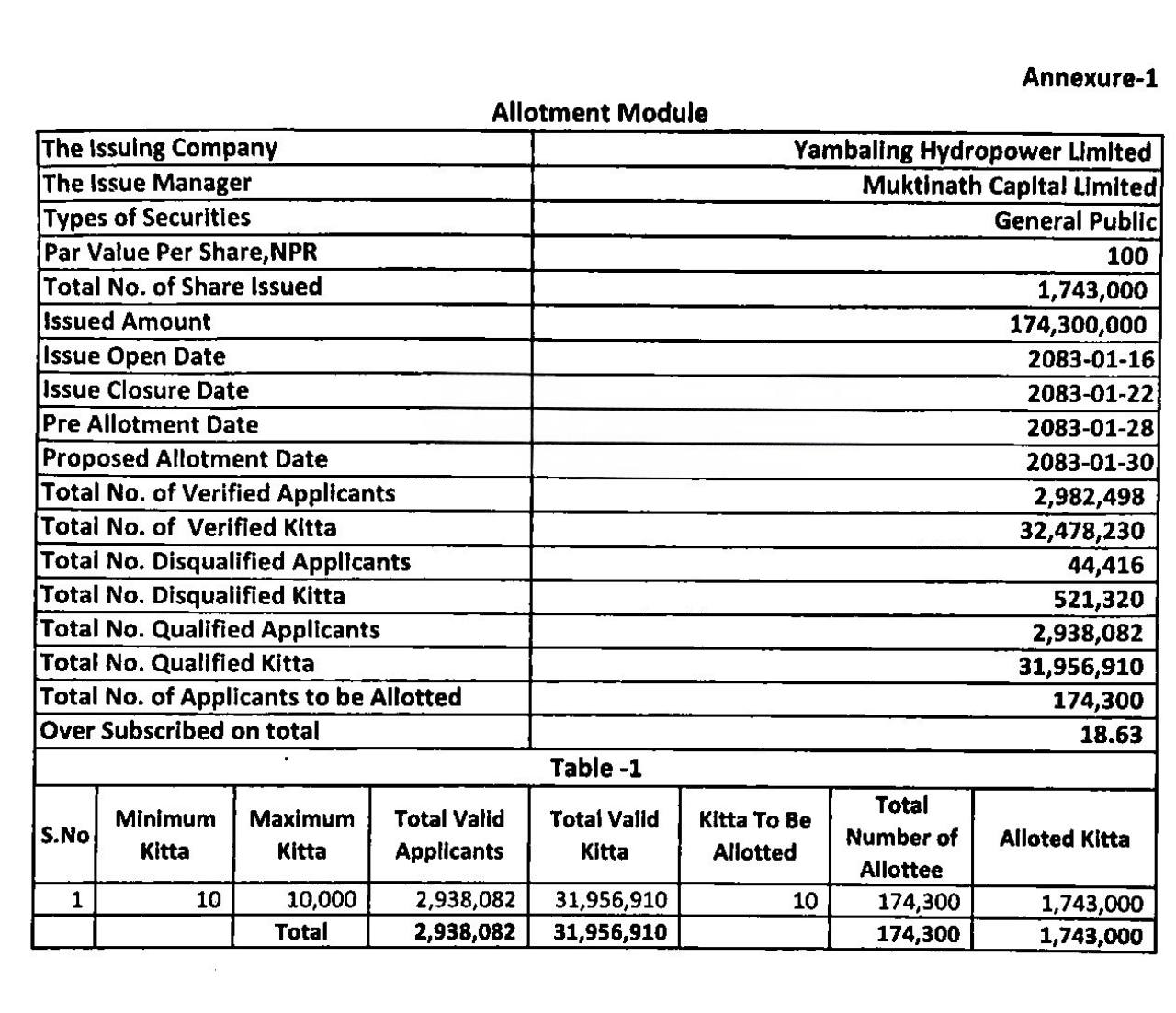
Due to the high demand, shares were allocated through a lottery system.
- A total of 1,74,300 applicants were successful
- Each lucky applicant received 10 units of shares
This type of distribution is common in highly oversubscribed IPOs, ensuring fair allocation among retail investors.
How to Check IPO Results
Investors can view their allotment status through the following platforms:
- CDSC IPO Result System
- MeroShare portal
- Muktinath Capital Limited official channels
These platforms provide real-time IPO result updates and portfolio information for applicants.
Credit Rating and Financial Risk Overview
The credit profile of the company has been evaluated by CARE Ratings Nepal Limited (CRNL), which reaffirmed the issuer rating at CARE-NP BB- (Is).
This rating indicates:
- A moderate level of credit risk
- Timely debt repayment capacity exists, but may be affected by economic or operational conditions
Such ratings help investors assess the financial stability of hydropower companies before investing.
About Yambaling Hydropower Limited
Yambaling Hydropower Limited is a Nepal-based hydropower developer established in 2007 and later converted into a public company in 2021.
Key Project Details:
- Operates the 7.27 MW Yambaling Khola Hydropower Project
- Located in Sindhupalchok District, Nepal
- Developed under a Run-of-River model
- Commercial operations began on February 20, 2024
- Structured under a BOOT (Build, Own, Operate, Transfer) arrangement
The company plays a growing role in Nepal’s renewable energy sector, contributing to national power generation capacity.
The IPO of Yambaling Hydropower Limited demonstrated strong investor interest, with applications far exceeding available shares. The final allotment, conducted via lottery, allocated shares to 1,74,300 lucky investors.
With its operational hydropower project and moderate credit rating, the company remains a notable player in Nepal’s expanding energy market.
For investors, this IPO highlights both the strong demand for hydropower stocks and the competitive nature of Nepal’s primary market.