
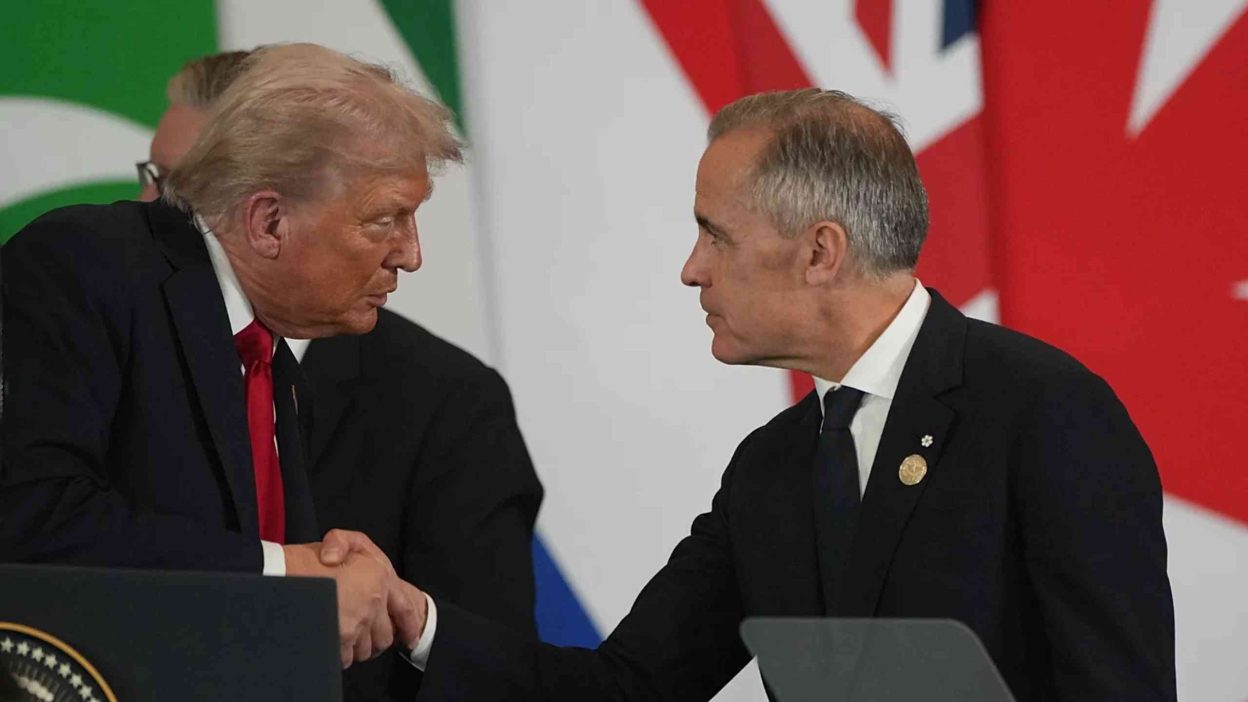
U.S. President Donald Trump has publicly threatened to impose a 100 % tariff on all Canadian imports if Canada moves forward with a trade agreement involving China, an abrupt escalation in tensions between Washington and Ottawa that could reshape North America’s economic landscape.
Trump’s threat came on January 24, 2026, after Canadian Prime Minister Mark Carney secured a deal in China addressing tariff reductions on products like electric vehicles and agricultural goods. Trump warned that such a deal could turn Canada into a “drop-off port” for Chinese products entering the U.S. market, a scenario he said would trigger the punitive tariff.
In a social media post on his Truth Social platform, Trump wrote that “China will eat Canada alive, completely devour it, including the destruction of their businesses, social fabric, and general way of life” if Canada pursues deeper trade ties with China. He added that Canada would be hit with a 100 % tariff on all Canadian goods and products coming into the United States if a deal is finalized.
Trump Says Greenland Tariff Threats Won’t Kill Europe Trade Deal
Context and Diplomatic Fallout
Sharpening Rhetoric With Canada
The tariff threat marks a sharp turn in U.S.–Canada relations, which had been generally cooperative but have recently frayed over competing economic and geopolitical priorities. Carney’s efforts to diversify trade relationships and reduce reliance on the U.S. align with Ottawa’s global strategy, but have drawn ire from the White House.
Carney’s speech at the World Economic Forum in Davos this month, in which he alluded to a “rupture” in the global order and urged cooperation among middle powers, reportedly provoked a confrontational response from Trump. The U.S. president also revoked Canada’s invitation to his proposed diplomatic “Board of Peace” initiative amid the clash.
Ottawa Pushes Back
Canada’s government quickly sought to clarify that it is not currently pursuing a free trade agreement with China, with Canada-U.S. Trade Minister Dominic LeBlanc stating that recent negotiations with Beijing were aimed at resolving specific tariff issues rather than pursuing full free trade. He stressed the importance of the long-standing economic partnership with the United States.
Economic Implications
• A 100 % tariff, essentially doubling duties, would dramatically raise the cost of Canadian goods entering the U.S., potentially disrupting sectors such as automotive, metals, and machinery that rely on cross-border supply chains.
• The U.S. and Canada have one of the world’s largest bilateral trade relationships, with hundreds of billions of dollars of flows annually; any escalation could slow economic growth and inflate prices on both sides of the border.
• Businesses and markets may react to rising uncertainty, as tariff risks typically undermine investment confidence and complicate long-term planning.
Near-Term Outlook
• Canada will likely defend its trade policy while highlighting the importance of deep economic ties with the U.S. Ottawa has already emphasized that no free trade deal with China is being pursued.
• U.S. political pressure may build as lawmakers and industry groups respond to national security narratives tied to China and trade.
• Financial markets may watch closely for potential spillover effects on equities and currency markets if the threat persists or tariff measures are enacted.
Why This Matters
• A 100 % tariff threat is unprecedented among close trading partners and signals growing protectionist pressure in U.S. trade policy.
• It could strain diplomatic ties between the U.S. and Canada at a time of broader global tension involving China and economic alliances.
• Businesses and workers on both sides of the border could see real-world economic impacts if tariffs disrupt established supply chains.
Summary
• President Trump threatened to impose a 100 % tariff on Canadian imports if Canada completes a trade deal with China, framing the move as a response to potential economic risk.
• The dispute follows Ottawa’s recent trade negotiations in Beijing and remarks by Prime Minister Mark Carney aimed at diversifying economic partnerships.
• Canada insists it is not pursuing a full free trade agreement with China, emphasizing its strong economic ties with the U.S. amid rising tensions.