
NYSE Texas is a fully electronic national securities exchange launched by the New York Stock Exchange and its parent company, Intercontinental Exchange (ICE). It began operations in March 2025 after the NYSE repurposed and reincorporated its former Chicago trading venue into a Texas-based exchange.
Headquartered in Dallas, NYSE Texas offers companies a regional alternative within one of the fastest-growing business environments in the United States.
By 2026, it has quickly established itself as a cornerstone of the “Y’all Street” movement, providing a local home for corporations in a state that already hosts more NYSE-listed companies by value than any other.
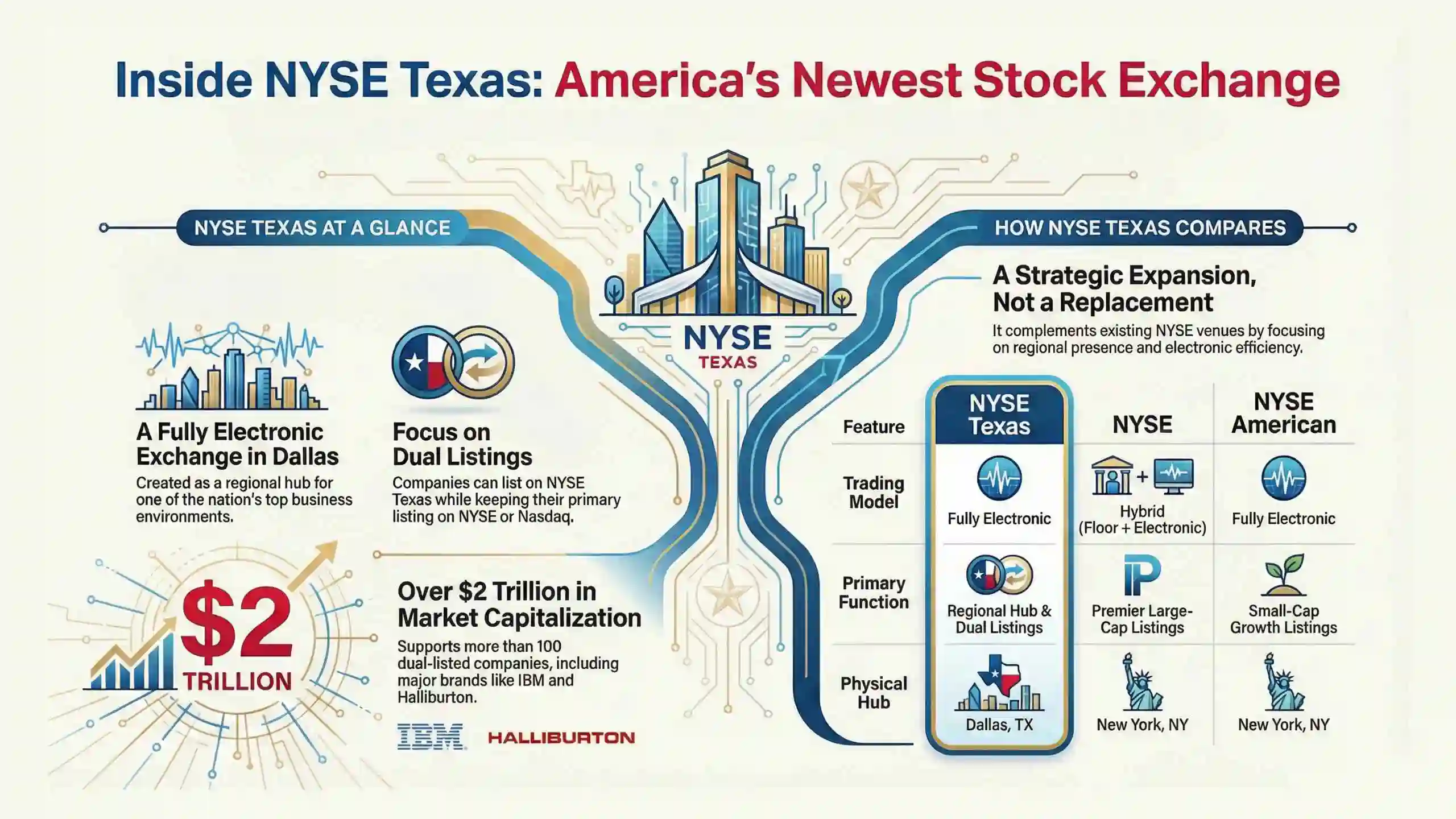
NYSE Texas at a Glance
| Attribute | Details |
| Exchange Name | NYSE Texas |
| Regional Hub | Dallas, Texas |
| Data Hub | Mahwah, New Jersey (ICE Data Center) |
| Launch Date | March 31, 2025 |
| Owner | Intercontinental Exchange (ICE) |
| Exchange Type | National Securities Exchange |
| Primary Focus | Fully electronic equities & Dual Listings |
| Trading Model | Price/time priority on NYSE Pillar technology |
| Regulatory Oversight | U.S. Securities and Exchange Commission (SEC) |
Why NYSE Texas Still Matters in 2026?
NYSE Texas represents a strategic expansion of the NYSE franchise into the U.S. Southwest. It provides:
- Regional presence: A Dallas-based venue for listings and trading in a major economic hub.
- Electronic equity execution: Fully electronic trading with advanced NYSE Pillar infrastructure.
- Dual Listing Advantage: Companies can dually list on NYSE Texas alongside their primary listing (NYSE or Nasdaq) to signal commitment to the Texas business ecosystem.
- Market Scale: As of early 2026, the exchange supports over 100 dual listings with a combined market capitalization exceeding $2 trillion.
Texas already hosts more NYSE-listed companies than any other U.S. state by combined market value, a dynamic that supports NYSE Texas’s growth potential.
What Is Actually New in 2026?
Unlike established exchanges, NYSE Texas is a recently created venue, and much of its newness comes from its rapid adoption and strategic positioning.
Key Developments to Know
| Area | 2026 Status |
| Fee Structure | SR-NYSETX-2026-01: Synchronized CRD system fees with new FINRA standards ($70–$125) effective Jan 2026. |
| Listing Growth | Surpassed the 100-company milestone in late 2025; now adding mid-cap and energy sector leads. |
| Corporate Governance | Now offers issuers the protections of the Texas Business Courts (resembling the Delaware Court of Chancery) and pro-business legislation regarding shareholder rights and C-suite protection. |
| Technology | Full integration of the 2026 Pillar Gateway updates for enhanced “Self-Trade Prevention.” |
These developments reflect both issuer demand and the strength of Texas as a business environment.
Listings and Market Position
NYSE Texas complements existing venues by offering Dual Listing opportunities. This allows a company’s stock to be traded on both its primary exchange and NYSE Texas simultaneously, often with streamlined compliance requirements.
2026 Listings Snapshot
| Category | High-Profile Examples (2026) |
| Operating Companies | AbbVie Inc. (ABBV), Allstate (ALL), Waste Connections (WCN) |
| Energy & Infrastructure | Halliburton (HAL), Texas Pacific Land (TPL), Vistra Corp (VST) |
| ETFs & Trusts | Invesco Municipal Trust (VKQ), God Bless America ETF (YALL) |
| Technology | Q2 Holdings (QTWO), IBM (IBM) |
These listings span a broad mix of sectors, illustrating the diverse issuances that NYSE Texas supports.
Market Focus and Who Trades on the NYSE Texas
NYSE Texas supports a mix of participants and use cases, including:
| Participant Type | Role |
| Institutional Investors | Efficient execution across equities |
| Retail Platforms | Access to trading in dual-listed stocks |
| Market Makers | Provide liquidity in the electronic order book |
| Dual-Listed Issuers | Use NYSE Texas for additional exposure |
Because the exchange is fully electronic, trading activity is driven by speed, algorithmic order flow, and competitive pricing.
NYSE Texas vs Other NYSE Group Venues
Though part of the NYSE Group, NYSE Texas serves a different strategic purpose than the flagship NYSE or NYSE American.
| Feature | NYSE Texas | NYSE | NYSE American |
| Primary Function | Electronic equities and venue expansion | Premier large-cap listings | Small-cap growth listings |
| Physical Presence | Dallas (regional focus) | NYC (flagship) | NYC (issuer focus) |
| Trading Model | Fully electronic | Hybrid (floor + electronic) | Fully electronic |
| Listing Scope | Dual listings | Primary listings | Primary listings |
Within the NYSE Group, NYSE Texas focuses on regional electronic trading, NYSE American lists large-cap leaders, NYSE American serves growth companies, and NYSE Arca specializes in ETFs and electronic products.
Practical Tips for Beginners
| Topic | Key 2026 Takeaway |
| Trading Hours | Standard U.S. session (9:30 AM – 4:00 PM ET). |
| Price Discovery | The NBBO automatically compares prices between the primary exchange and NYSE Texas. |
| Branding | Listing here is a “branding move” to align with the Texas economic boom. |
| Order Routing | Automatic. Your broker routes trades to NYSE Texas if it offers the best price. |
Investors new to NYSE Texas should understand that dual listings may affect where orders are routed, but primary liquidity often remains on the main exchange where the stock is listed.
Final Thoughts
In 2026, NYSE Texas is a young but notable addition to the U.S. equity landscape. By combining NYSE infrastructure with a Texas base, it offers companies and investors expanded flexibility and regional presence.
For beginners, NYSE Texas highlights how capital markets are evolving geographically and how electronic venues support greater choice in trading execution.
Readers looking for the complete U.S. stock exchanges list can explore our detailed guide.
Frequently Asked Questions
Is NYSE Texas a fully independent exchange?
Yes. NYSE Texas is an SEC-registered national securities exchange. While it operates independently, it shares ownership and core technology with the broader NYSE Group.
Does NYSE Texas have a physical trading floor?
No. NYSE Texas is a fully electronic exchange. Although its headquarters and executive offices are based in Dallas, its matching engine operates from the ICE Data Center.
Can a company dually list on NYSE Texas for free?
Many dual listings on NYSE Texas are structured to minimize or eliminate additional costs for companies already listed on NYSE or NYSE American, making it an attractive regional extension.
Disclaimer: Investing involves risk. This content is for educational purposes only and does not constitute financial advice.