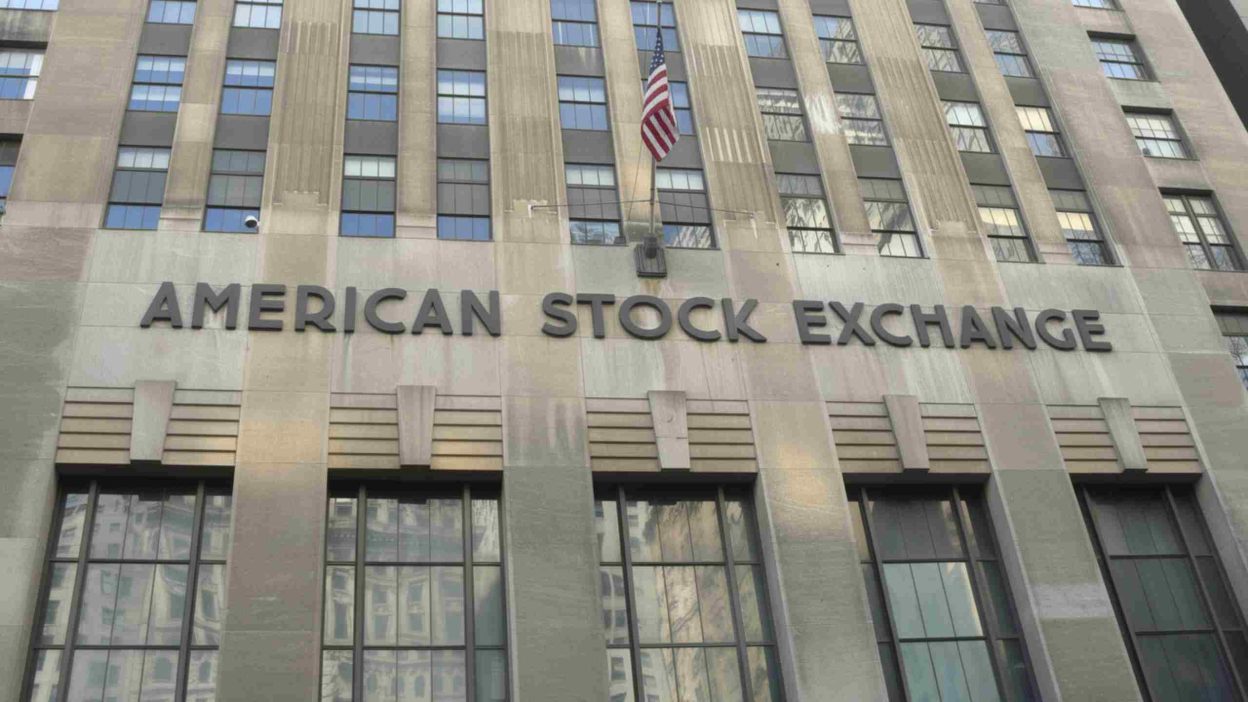
NYSE American is a U.S. national securities exchange designed specifically for small-cap and growth-oriented companies. Operated by Intercontinental Exchange (ICE), it occupies a distinct position within the NYSE Group as a stepping-stone market for issuers that are not yet ready for the scale and costs of a full NYSE listing.
Formerly known as the American Stock Exchange (AMEX), NYSE American blends modern electronic trading with issuer-focused flexibility. In 2026, it continues to serve emerging companies across sectors such as biotechnology, mining, clean energy, and early-stage technology.
For new investors, NYSE American represents the earlier stage of the public company lifecycle, where growth potential is higher but risk is also meaningfully elevated.
NYSE American at a Glance
| Attribute | Details |
| Exchange Name | NYSE American |
| Physical Hub | New York City |
| Data Hub | Mahwah, NJ (ICE Data Center) |
| Founded | 1842 (as AMEX) |
| Owner | Intercontinental Exchange (ICE) |
| Exchange Type | National Securities Exchange |
| Primary Focus | Small-cap and growth equities |
| Trading Model | Electronic Price/Time Priority (with e-DMMs) |
| Regulatory Oversight | U.S. Securities and Exchange Commission (SEC) |
Why NYSE American Still Matters in 2026
NYSE American plays a critical role by supporting capital formation for smaller public companies that may be overlooked on larger exchanges.
- Access to Capital: Enables early-stage firms to raise public equity.
- Graduation Pathway: Serves as a feeder market to NYSE for successful issuers.
- Issuer Flexibility: Lower initial listing costs compared to NYSE.
- Visibility: National exchange status enhances credibility versus OTC markets.
For investors, NYSE American offers exposure to companies earlier in their growth journey.
What Is Actually New in 2026?
NYSE American has focused less on structural reinvention and more on regulatory quality and issuer discipline.
Key Developments to Know
| Area | 2026 Status |
| Listing Standards | New $4.00 minimum for initial listings (Jan 2026 rule) |
| Market Surveillance | AI-driven monitoring for 0DTE-related price spikes |
| Delisting Policy | Immediate suspension if share price hits $0.25 |
| Settlement | Full integration with T+1 and instant-tokenized pilot programs |
These changes aim to improve market quality while preserving access for legitimate growth companies.
Listing Standards and Market Discipline
One of the most significant shifts in 2026 is the NYSE American’s move to align its “quality” metrics with the main NYSE board.
Current Listing Discipline
| Requirement | General Expectation |
| Minimum Share Price | $4.00 for all new initial listings |
| Market Capitalization | Must meet requirements for 90 consecutive trading days for transfers |
| The “Floor” Price | $0.25 triggers immediate delisting (No cure period) |
| Governance | Independent audit committees and SEC-compliant disclosures |
This approach reduces the presence of speculative “zombie” companies and ensures that even small-cap stocks on the exchange meet a baseline of institutional quality.
Market Focus and Who Trades on NYSE American
NYSE American is known for hosting growth-stage and niche-sector companies.
Core Characteristics
- Concentration of small-cap issuers (Market cap often $50M to $1B).
- Strong presence in Biotechnology, Quantum Computing, and Specialty Tech.
- Higher volatility compared to NYSE-listed stocks due to lower float.
Who Dominates Trading Activity
| Participant Type | Role |
| Retail Investors | Primary liquidity source |
| Hedge Funds | Event-driven and speculative strategies |
| e-DMMs | Electronic Market Makers providing liquidity quotes |
| Institutional Funds | Selective participation |
Because institutional ownership is lighter, price swings tend to be sharper.
NYSE American vs The Main NYSE
While both utilize the Pillar matching engine in Mahwah, their daily operations differ significantly for the end investor.
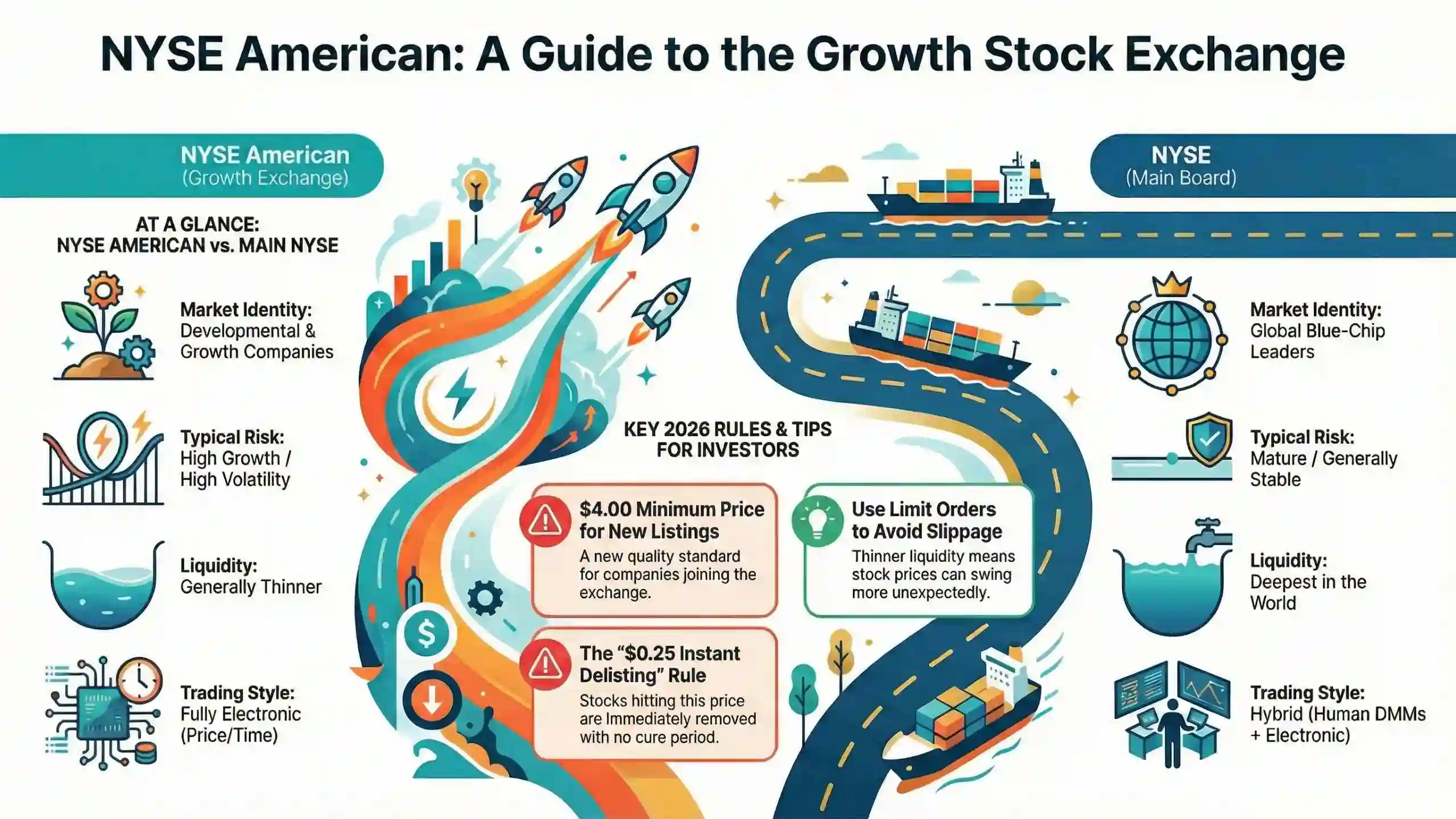
| Feature | NYSE American | NYSE (Main Board) |
| Market Identity | Developmental & Growth | Global Blue-Chip Leaders |
| Trading Style | Fully Electronic (Price/Time) | Hybrid (Human DMMs + Electronic) |
| Liquidity | Generally Thinner | Deepest in the World |
| Risk Profile | High Growth / High Volatility | Mature / Generally Stable |
For investors, the NY Stock Exchange Main Board typically offers tighter spreads, higher average daily volume, and lower volatility compared with NYSE American listings.
NYSE American is not a “junior” exchange in status, but it is a developmental marketplace by design.
Trading Model and Market Structure
Unlike the NYSE, NYSE American operates as a fully electronic exchange using the Pillar technology platform.
- Orders are matched electronically based on price and time priority.
- Uses Electronic Designated Market Makers (e-DMMs) rather than floor-based humans.
- Liquidity depends heavily on automated order flow.
This structure allows for rapid execution but can amplify volatility during news-driven events, as there is no human DMM to “slow down” a flash move.
Practical Tips for Beginners
| Topic | What to Know |
| Trading Hours | 9:30 AM to 4:00 PM Eastern Time |
| Liquidity | Often thinner; use Limit Orders to avoid slippage |
| The $0.25 Rule | Avoid stocks nearing $0.25; delisting is now instant |
| Due Diligence | Financial filings are critical for growth-stage firms |
Beginners should approach NYSE American stocks with research discipline and position sizing awareness.
Final Thoughts
In 2026, NYSE American remains an essential component of the U.S. market ecosystem. It provides legitimate companies with public market access while offering investors exposure to earlier-stage opportunities.
For beginners, NYSE American should be viewed as a growth-focused exchange, not a substitute for the stability of NYSE blue-chip stocks. Understanding this distinction is critical to managing expectations and risk.
Readers looking for the complete U.S. stock exchanges list can explore our detailed guide.
Frequently Asked Questions
Is NYSE American regulated by the SEC?
Yes. NYSE American is a fully registered national securities exchange
regulated by the U.S. Securities and Exchange Commission (SEC).
Are NYSE American stocks riskier than NYSE stocks?
Generally, yes. Companies listed on NYSE American are typically smaller,
with lower liquidity, higher volatility, and greater overall business risk.
Can companies move from NYSE American to NYSE?
Yes. Successful issuers that meet the main NYSE’s listing standards can
“uplist” from NYSE American to the primary NYSE exchange.
Disclaimer: Investing involves risk. This content is for educational purposes only and does not constitute financial advice.