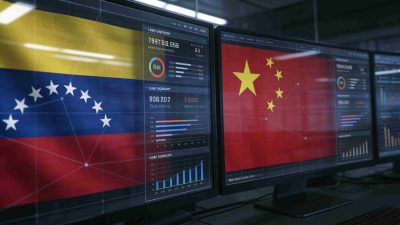
China’s top financial regulator has asked major banks and policy lenders to report their lending exposure to Venezuela in the wake of recent U.S. military action involving Venezuelan leadership. This reflects Beijing’s concern about how escalating geopolitical tensions could affect its financial system and banks’ credit portfolios.
For Americans watching global financial news, this development highlights how geopolitical events now influence banking risk monitoring and financial regulation far beyond domestic borders, especially when a country has large cross-border credit relationships. Understanding what China’s actions mean can help make sense of emerging financial and geopolitical risks.
Why This Is Happening
China has deep financial ties with Venezuela, built over the years through oil-for-loan deals and infrastructure funding extended mainly by China Development Bank and other policy banks. These loans total billions of dollars, and with the recent U.S. action destabilizing Venezuela’s political landscape, Chinese regulators want a clear picture of how local lenders might be exposed.
The National Financial Regulatory Administration (NFRA) issued the directive to banks to report their Venezuela-related credit exposure and strengthen monitoring of associated risks. This is intended to guard against sudden losses or shocks should conditions deteriorate in Venezuela or related credit markets.
The move follows earlier steps by authorities focused on Venezuela loan exposure amid rising geopolitical uncertainty.
Current Banking and Exposure Snapshot
| Item | Status / Focus |
|---|---|
| Regulator | National Financial Regulatory Administration (NFRA) |
| Target institutions | Policy banks, major commercial lenders in China |
| Required action | Report lending exposure to Venezuela |
| Risk focus | Strengthen monitoring of Venezuela-related credit |
| Context | Rising geopolitical risk after Venezuelan political events |
This action echoes heightened caution among financial authorities worldwide when international conflicts intersect with large credit exposures.
Why It Matters to Americans
1) Geopolitical Risk in Global Finance
China’s request comes amid geopolitical uncertainty following a dramatic U.S. operation involving Venezuelan leadership. When major economies pay attention to credit exposure tied to another country, it shows how interconnected global banking networks are.
2) Potential Market Signals
Stronger oversight and reporting requirements often signal that regulators are trying to identify concentrations of risk before losses are realized. For global markets, this can be a signal that broader financial conditions, not just political rhetoric, are being taken seriously by regulators.
3) Impact on Oil and Funding Partnerships
China’s financial relationship with Venezuela historically involved loans backed by oil supplies. If risk becomes harder to manage or loans deteriorate, this could affect long-term energy financing strategies and credit conditions for similar deals elsewhere.
Comparisons and Broader Context
| Region | Typical Regulatory Focus | Current Highlight |
|---|---|---|
| U.S. | Bank capital, consumer protection | Focus on stress testing, credit exposure |
| Europe | Cross-border exposures, ECB supervision | Monitoring sovereign risk |
| China | Systemic stability, credit risk | Tracking exposure to geopolitical stress points |
China’s focus on Venezuela illustrates how bank regulators increasingly account for geopolitical risk alongside traditional credit risks, especially when credit involves state backing rather than purely commercial lending.
Practical Takeaways
Lenders must disclose foreign credit exposure: Reporting requirements help regulators understand potential weak points in bank balance sheets.
Geopolitical events can trigger financial oversight actions: When conflict or sudden political change occurs, regulators may take steps to pre-empt financial contagion or unexpected losses.
Risk monitoring is expanding beyond domestic borders: Global banks and policy lenders may face increased scrutiny of international credit as political risks rise.
China’s request for banks to report their exposure to Venezuela highlights how global geopolitical shocks now intersect with financial regulation and credit risk oversight. With years of lending tied to Venezuela, particularly through oil and infrastructure deals, Chinese regulators want to ensure that lenders understand and manage the possible fallout from recent events. For U.S. observers and global markets, this underscores that banking risk is not only about local conditions: cross-border credit and foreign policy can matter to financial stability too.
Frequently Asked Questions
Why did Chinese regulators ask banks to report Venezuela exposure?
Regulators want to assess potential financial risks from loans and credit lines tied to Venezuela, especially following recent geopolitical developments.
What kinds of banks are affected by the request?
The request applies to China’s policy banks and other major lenders with international credit portfolios.
Does this mean China expects losses?
Not necessarily. The aim is to identify and monitor financial risks more closely, not to signal imminent losses.
How are China–Venezuela financial ties structured?
Much of the exposure comes from large, state-backed loans, often connected to oil and infrastructure projects.
Could this affect global financial markets?
Heightened monitoring can influence market sentiment and underscores the financial impact of geopolitical instability.
China’s banking regulator has asked major banks to disclose their exposure to Venezuela after recent geopolitical events, aiming to improve oversight of credit risk tied to foreign lending; this move highlights how geopolitical developments are shaping financial regulation globally.