
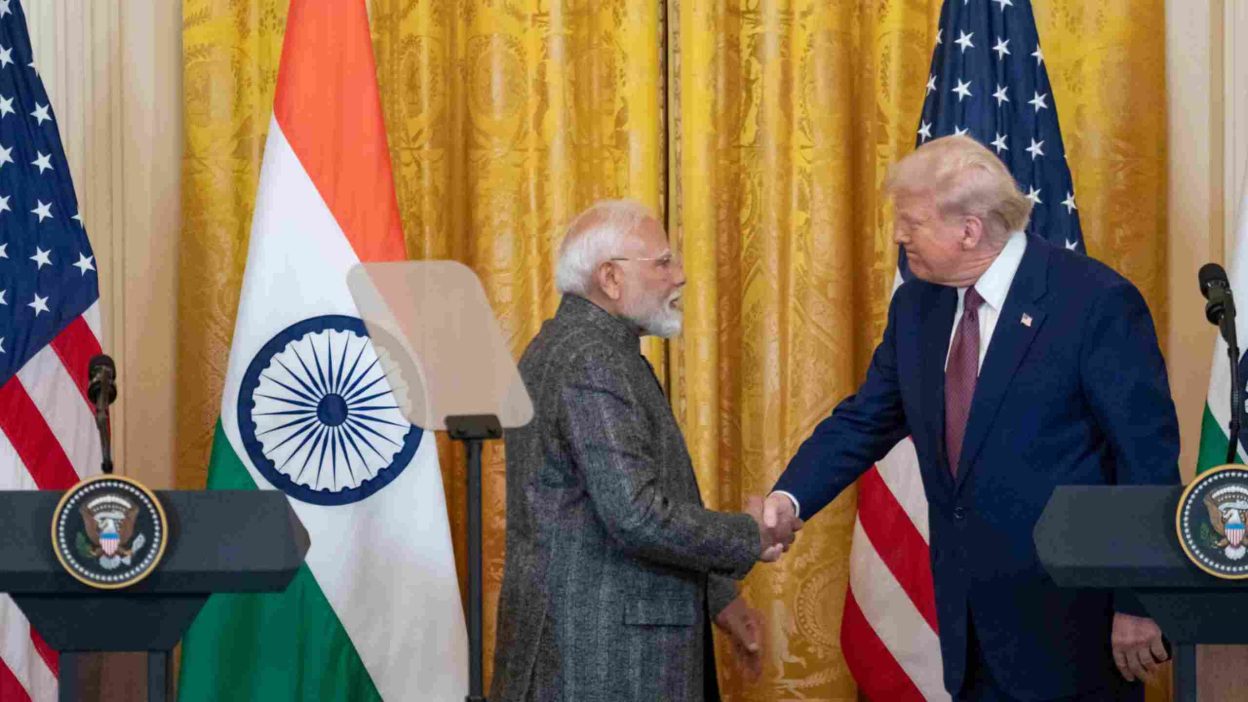
President Donald Trump announced that the United States and India have agreed to a new trade deal, with both sides describing changes to tariffs and trade relations after a phone call with Indian Prime Minister Narendra Modi. The announcement comes amid months of tariff tensions between the two countries and broader global trade pressures.
In Trump’s announcement, he said India would make significant adjustments to its energy purchases while Washington would cut tariffs on Indian imports. India’s stock markets and currencies reacted positively.
Why This Is Happening
The deal reflects ongoing discussions between Washington and New Delhi to ease trade tensions that began in 2025, when the U.S. imposed high tariffs on Indian goods, partly tied to India’s large purchases of discounted Russian oil. Trump framed the new terms as a “historic” agreement that strengthens economic ties and energy cooperation.
Trump’s statement emphasized that India agreed to stop buying Russian oil and to boost purchases of U.S. energy and other goods as part of the arrangement. Prime Minister Modi publicly welcomed the tariff reduction but did not directly confirm the oil purchase pledge in his own statement.
The deal follows India’s recent budget measures aimed at cushioning the economy from renewed U.S. trade pressure.
Key Trade Deal Details
| Component | What’s Reported |
|---|---|
| U.S. tariffs on Indian goods | Reduced from 25% to 18% |
| Penalty tariffs tied to Russian oil | Dropped |
| India’s tariff barriers on U.S. goods | Reportedly set toward zero |
| India’s energy purchases | Trump said India will stop buying Russian oil and buy more U.S. energy |
| Trade and product commitments | India to potentially buy $500 billion in U.S. goods |
This shift marks a reversal from the higher tariff regime imposed last year, when U.S. duties on Indian products climbed to effectively 50% due to punitive levies linked to energy imports.
Why It Matters to Americans
Tariff impact on prices and exporters
Lower U.S. tariffs on Indian goods could reduce costs for American importers and provide more competitive access to Indian products. Millions of U.S. consumers and businesses that source parts, textiles and services may benefit from eased trade barriers.
Energy and geopolitical context
Trump linked the deal to India shifting away from Russian oil, which has been a major source of discounted crude for New Delhi and a point of U.S. contention tied to the war in Ukraine. The change could influence global energy flows and market pricing.
Investment and market reaction
Indian and global stock markets reacted positively to the tariff cuts, with indices and currencies strengthening on expectations of smoother trade relations and potential surge in U.S. exports.
Key Comparisons
| Element | Before Deal | After Deal (Reported) |
|---|---|---|
| U.S. tariffs on Indian goods | 25% base + 25% penalty | 18% from standard tariffs |
| India’s energy imports | Heavy reliance on Russian oil | Reported shift to U.S. or other sources |
| India tariff on U.S. imports | Various duties | Targeted reductions toward zero |
| Trade balance outlook | Tense, tariff-driven | More cooperative and aligned |
This table highlights how the trade relationship is evolving from punitive tariffs toward negotiated reductions and increased cooperation.
Near-Term Outlook
As the deal rolls out, markets will watch how tariff changes are implemented in practice, how quickly India adjusts its import patterns, and whether formal legal and regulatory frameworks are finalized. The long-term implications for global trade and energy markets will depend on follow-through from both governments and evolving geopolitical conditions. No predictions or guarantees are implied.
Practical Takeaways
The United States plans to cut tariffs on Indian goods from 25% to 18% as part of a reported trade agreement with India.
The U.S. will also remove penalty tariffs tied to India’s purchases of Russian oil.
Trump said India agreed to stop buying Russian oil and increase purchases of U.S. energy and other products.
India acknowledged the tariff cut and expressed support for stronger cooperation but did not publicly restate all energy commitments cited by Trump.
Market reaction included gains in Indian stock markets and stronger currency movements.
Bottom Line
The reported U.S.-India trade deal marks a notable shift from earlier tariff tensions toward more cooperative economic ties, with reduced tariffs and energy-linked commitments featured prominently in official statements. While U.S. and Indian leaders have framed the agreement as beneficial for both economies, details remain partly conditional and will require ongoing negotiation, implementation and monitoring across sectors including energy, manufacturing and agriculture.
Frequently Asked Questions
What changes to tariffs did the U.S. announce for Indian imports?
President Trump said the U.S. will cut tariffs on Indian goods from 25% to 18% and remove additional penalty tariffs that were linked to India’s earlier purchases of Russian oil.
Did India agree to stop buying Russian oil?
Trump claimed India agreed to halt Russian oil purchases and boost imports of U.S. energy. However, Indian officials have publicly confirmed only the tariff reduction so far.
How could this affect U.S. companies?
Lower tariffs may reduce costs for U.S. firms importing goods from India, while India’s increased purchases of U.S. energy and other products could support American exports.
Is this a formal treaty?
No. The announcement reflects an agreed framework described by leaders and officials. Legal implementation and final details may still require further negotiations and documentation.
What else is included in the deal?
Trump said India would reduce tariffs and non-tariff barriers on U.S. goods, potentially to zero-and commit to large purchases of U.S. energy, technology, and agricultural products.
President Trump announced a trade agreement with India that reduces U.S. tariffs on Indian goods to 18% and removes penalty levies tied to Russian oil, while India expressed support for stronger cooperation and confirmed the tariff change, in a move seen as easing recent trade tensions.