The dramatic rise and fall of Oracle (ORCL) stock in 2025 perfectly captures the biggest question facing today’s tech investors: Is artificial intelligence a once-in-a-generation opportunity, or is it creating the next major financial bubble?
Oracle’s journey this year shows how quickly excitement around AI can turn into concern, and how fragile market confidence can be when massive investments are funded by debt rather than cash.
A Powerful Start Fueled by AI Optimism
Oracle entered 2025 with strong momentum. Early in the year, the company announced a high-profile AI infrastructure partnership with OpenAI and SoftBank under a project called Stargate. The group pledged up to $500 billion to expand AI data centers across the United States.
The announcement gained even more attention when it was revealed at the White House, with former President Donald Trump and top executives, including Oracle chairman Larry Ellison, present during the event. Markets reacted immediately, pushing Oracle shares sharply higher.
Earnings, AI Deals, and a Surging Stock Price
Investor enthusiasm didn’t stop there. Oracle’s quarterly earnings reports in June and September further strengthened the AI narrative. Management highlighted strong demand for cloud services and AI-related contracts, projecting that Oracle’s cloud revenue could reach $166 billion by 2030.
By September, Oracle stock had climbed so rapidly that Larry Ellison briefly became the world’s richest person, reflecting the intense optimism surrounding AI investments.
When Excitement Turned Into Doubt
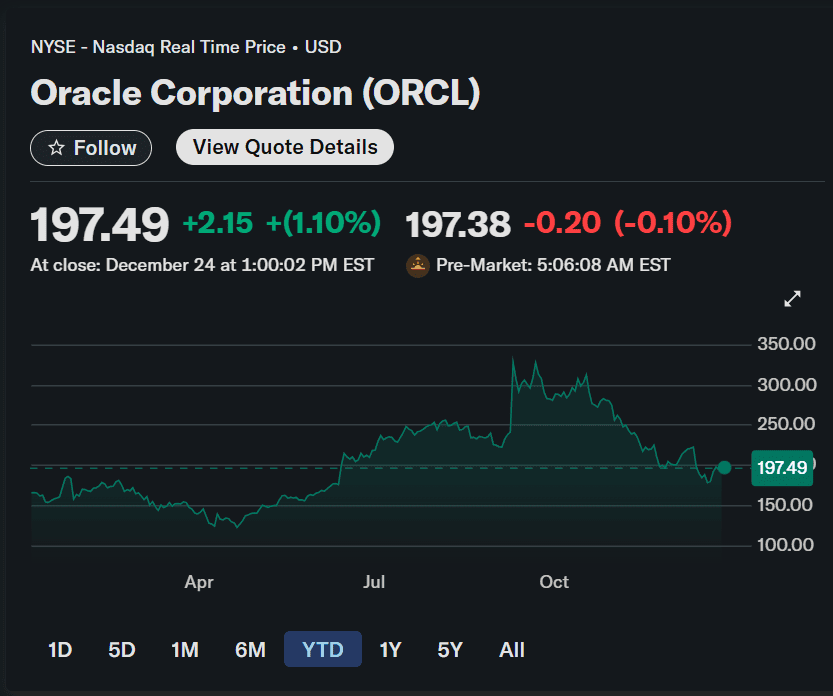
However, the rally did not last. As the year progressed, investors began questioning how tech companies were financing their aggressive AI expansion. The biggest concern was debt.
Oracle, in particular, drew scrutiny after issuing nearly $26 billion in bonds during the year. Total company debt jumped 40% year over year, reaching $124 billion, while cash outflows surged to $10 billion.
This shift made investors uneasy, especially as returns from AI infrastructure remain uncertain.
Rising Credit Risk and CDS Market Warnings
Signs of concern appeared in the credit markets. Credit default swaps (CDS), instruments used to insure against corporate default, began trading more actively for major tech firms, including highly rated companies like Microsoft and Alphabet.
According to S&P Global Market Intelligence, Oracle’s CDS costs rose sharply, reaching their highest level since 2009. This indicated growing fear among investors that heavy borrowing could increase financial risk.
One analyst described Oracle as the “poster child” for worries around a potential AI bubble.
Hidden Commitments Raise More Questions
Further concerns emerged after Oracle disclosed additional long-term lease obligations. In a regulatory filing, the company revealed nearly $248 billion in future lease commitments, mostly related to data centers, scheduled to begin between fiscal years 2026 and 2028.
These obligations do not appear directly on Oracle’s balance sheet, making some investors nervous about the company’s true financial exposure.
Analysts warned that such commitments leave Oracle with little margin for error if AI demand fails to meet expectations.
Heavy Dependence on OpenAI
Oracle’s partnership with OpenAI also became a source of uncertainty. OpenAI reportedly accounts for over $300 billion of Oracle’s remaining performance obligations, essentially future revenue tied to long-term contracts.
When this detail became public, Oracle’s stock fell sharply from its September highs. Investors questioned whether OpenAI could realistically meet its ambitious revenue goals, especially as competition intensifies from rivals like Google.
Adding to the concern, OpenAI is expected to spend an estimated $1.4 trillion over the next eight years on AI infrastructure, involving multiple partners such as Nvidia, AMD, Broadcom, and Oracle.
Is AI Demand Being Overestimated?
Another major worry is whether AI demand will grow as fast as companies predict. Some analysts argue that businesses renting AI computing power are still struggling to turn AI into profitable products.
Until customers can generate consistent revenue from AI, data center investments may take longer to deliver meaningful returns.
Oracle has stated that its AI infrastructure can be repurposed for other clients if needed, but market confidence remains cautious.
Project Delays and Partner Changes
Reports also surfaced about possible delays in Oracle’s data center projects. Some contracts tied to OpenAI were reportedly pushed back from 2027 to 2028, though Oracle denied any delays.
Separately, media reports claimed that Blue Owl, a key data center partner, would not support a major Michigan project. Oracle responded by saying a different equity partner had already been secured.
Leadership Changes Add Another Layer of Uncertainty
At the same time, Oracle went through a leadership transition. In late September, longtime CEO Safra Catz stepped down and joined the board, while Clay Magouyrk and Mike Sicilia took over as co-CEOs.
Leadership changes during periods of financial stress often add uncertainty, even when investors remain confident in management’s experience.
Where Oracle Stock Stands Now
As of late December 2025:
Oracle shares are down more than 40% from their September peak
The stock is still up around 15% for the year, showing mixed sentiment
Investors remain divided between long-term belief and short-term caution
Despite the challenges, some long-time Oracle investors remain optimistic, pointing to the company’s history of adapting and outperforming competitors over time.
Final Thoughts: Opportunity or Overreach?
Oracle’s 2025 story reflects a broader market debate. AI has enormous potential, but turning that potential into sustainable profits requires time, discipline, and careful financial management.
For now, Oracle stands at a crossroads, balancing bold ambition against growing investor skepticism. Whether AI proves to be Oracle’s greatest growth engine or its biggest risk will likely define the company’s next decade.