Nepal Rastra Bank (NRB) has maintained its flexible monetary policy stance in the third-quarter review of the current fiscal year, signaling continuity in its approach as Nepal’s banking system continues to face excess liquidity. The central bank kept major policy tools unchanged while emphasizing financial stability, moderate inflation, and support for economic recovery.
NRB Keeps Key Policy Rates Unchanged
In its latest quarterly review, the central bank decided not to change major monetary policy measures, including:
- Cash Reserve Ratio (CRR)
- Statutory Liquidity Ratio (SLR)
- Interest rate corridor structure
- Bank rate policies
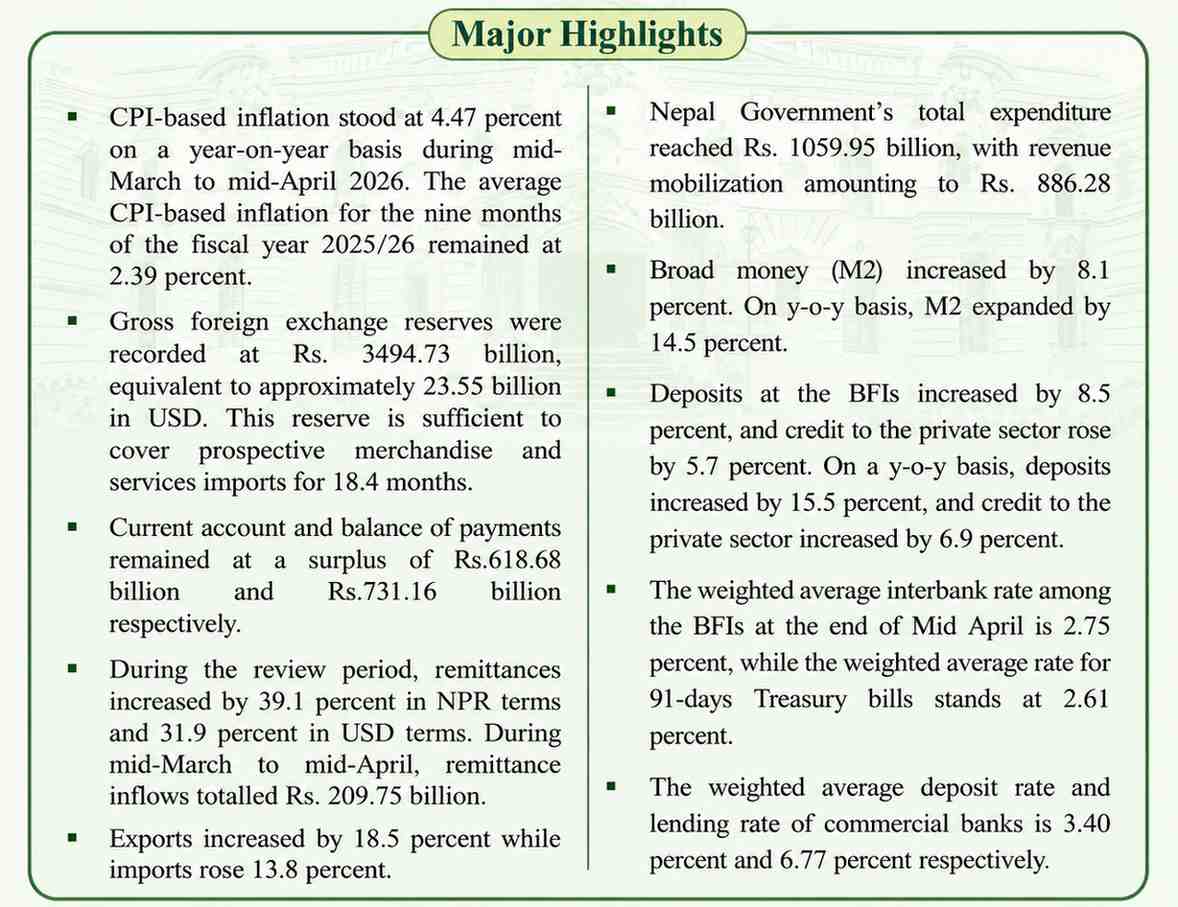
According to NRB, the current policy direction remains focused on balancing economic growth with price stability. The review noted that Nepal’s inflation remains within the targeted range, while foreign exchange reserves continue to stay strong due to higher remittance inflows.
Major Highlights of the Monetary Policy
Excess Liquidity Still a Major Issue
Nepal’s banking system has remained highly liquid for nearly three years. In response, NRB has repeatedly absorbed excess funds from banks through deposit collection instruments and liquidity management operations.
The central bank recently conducted large-scale liquidity absorption operations, including:
- Rs. 120 billion deposit collection operation in April 2026
- Rs. 40 billion liquidity absorption in February 2026
These measures are intended to prevent excessive money supply from creating inflationary pressure or weakening financial stability.
Inflation Remains Under Control
NRB stated that average consumer inflation has remained below the official target.
Key inflation highlights include:
- Average consumer inflation stood at around 2.39% during the review period
- Year-on-year inflation reached 4.47% by mid-April 2026
- Inflation is still considered manageable under current policy targets
The central bank also warned that global geopolitical tensions and fluctuations in oil prices could create future inflation risks.
Foreign Exchange Reserves Stay Strong
Nepal’s external sector remains stable due to rising remittance inflows and tourism recovery.
According to recent macroeconomic data:
- Foreign exchange reserves are sufficient to cover more than 18 months of imports
- Remittance inflows increased significantly during the first nine months of the fiscal year
- Current account and balance of payments positions remain positive
However, NRB noted that Nepal remains vulnerable to global economic uncertainty, especially because a large portion of remittances comes from Gulf countries and West Asia.
Economic Growth Shows Gradual Improvement
The central bank expects Nepal’s economy to gradually improve during the fiscal year.
Sectors showing recovery include:
- Wholesale and retail trade
- Tourism
- Hydropower
- Financial services
- Transportation and storage
- Information technology
NRB estimates Nepal’s economic growth rate at around 3.85% for the current fiscal year, although broader growth challenges remain.
Banking Sector Still Facing Loan Recovery Pressure
While liquidity remains high, banks continue to face pressure from rising non-performing loans (NPLs).
The central bank acknowledged:
- Loan recovery has slowed in recent years
- Non-performing loans have increased compared to previous years
- Capital adequacy ratios remain within regulatory limits
NRB said improving economic activity could help strengthen repayment capacity in the coming months.
What This Means
The third-quarter monetary policy review suggests that Nepal Rastra Bank is prioritizing stability over aggressive policy changes.
Key takeaways:
- Interest rates and liquidity policies remain largely unchanged
- Excess liquidity management remains a top priority
- Inflation and foreign reserves are currently stable
- Economic recovery is gradual but still uneven
- Banking sector risks continue to be monitored closely
For businesses, banks, and borrowers, the review signals policy continuity rather than sudden tightening or easing in the near term.