
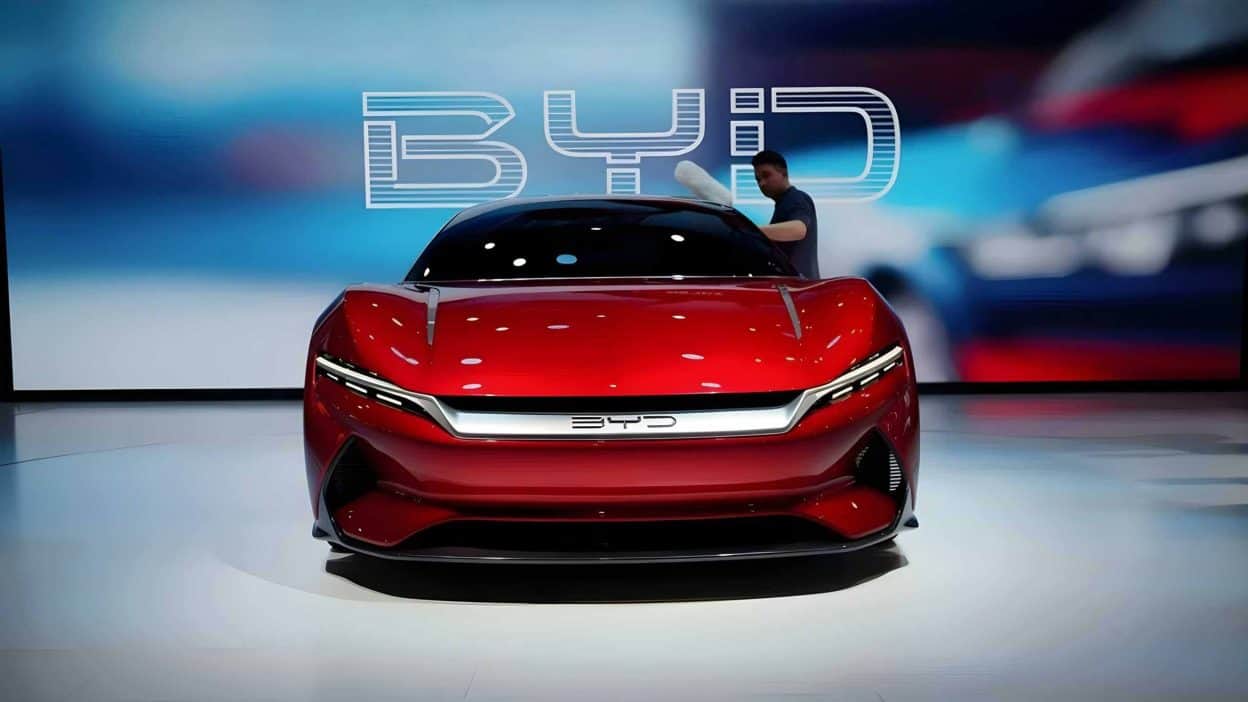
Chinese automaker BYD sold about 4.6 million vehicles in 2025, meeting its revised sales target and positioning itself to potentially outpace U.S. electric vehicle maker Tesla in annual deliveries. This marked a milestone for the Shenzhen-based company as demand for new energy vehicles (EVs) continues to reshape the global auto industry.
For everyday Americans, BYD’s performance highlights broader trends in the global EV market, including competition among manufacturers, evolving consumer preferences, and how companies adjust goals when expansion slows.
Why is this happening?
After years of rapid growth, BYD faced slower sales momentum at home in China as competition intensified, prompting the company to adjust its 2025 sales target downward before ultimately meeting it.
The company still managed to deliver about 4.6 million vehicles globally, up roughly 7–8 % from 2024. This increase came despite meaningful growth deceleration compared with earlier years of explosive expansion.
Current Sales Snapshot
| Measure | 2025 Outcome |
|---|---|
| Total vehicles sold | ~4.6 million |
| Year-over-year increase | +7 – 8 % |
| Target met | Yes (revised) |
| Tesla 2025 estimate | Lower than BYD’s total |
BYD’s performance reflected both ongoing overseas growth and domestic challenges amid price competition and market saturation.
Why It Matters to Americans?
BYD’s rise matters for several reasons:
Global EV leadership: If BYD outsells Tesla, it would signal a major shift in the global EV hierarchy and reflect how quickly the Chinese auto sector has scaled production.
Competitive pressure: U.S. automakers and EV companies face increasing competition from large, cost-effective producers abroad.
Electric vehicle adoption: BYD’s success shows how demand for EVs continues to expand beyond traditional markets and into developing regions, influencing where and how EVs are built and sold.
For U.S. consumers, this underscores how global competition and pricing pressure could affect EV availability, features, and cost over time.
Key Comparisons: Growth Trends
| Aspect | Earlier Years | 2025 |
|---|---|---|
| Annual sales growth | Rapid, double-digit increases | Slower, low single-digit growth |
| Sales volume | ~4.25 M in 2024 | ~4.6 M in 2025 |
| Market position | Leading Chinese EV maker | Potential global EV sales leader |
The slowdown in growth highlights that even fast-rising companies may hit natural limits as markets mature and rivals close gaps.
Practical Takeaways
Big numbers still matter: BYD’s 4.6 million units sold is one of the largest totals in the global vehicle market.
Targets can change: The company lowered and then met its sales goal, showing flexibility in planning when conditions shift.
Global expansion is key: Growth in overseas markets has helped offset slower domestic demand, pointing to a long-term strategy beyond China.
Conclusion
BYD’s meeting of its 2025 sales target marks a significant achievement in the global EV race, especially amid a slower growth environment in its home market. While competition is intensifying, delivering roughly 4.6 million vehicles globally reinforces BYD’s position as one of the most influential players in the shift toward electric mobility. For U.S. observers, this development sheds light on how production capacity, pricing strategy, and global demand are shaping the future of electric cars.
Frequently Asked Questions
How many vehicles did BYD sell in 2025?
BYD delivered approximately 4.6 million vehicles worldwide in 2025, representing growth of about 7–8% compared with 2024.
Did BYD meet its sales goals?
Yes. BYD met its revised sales target for 2025 after adjusting expectations in response to market challenges.
Is BYD ahead of Tesla?
Based on current figures, BYD’s total vehicle deliveries are expected to surpass Tesla’s 2025 deliveries.
Why was growth slower in 2025?
Growth slowed due to intensified competition in China, leading BYD to lower its original target before ultimately meeting the revised goal.
Where is BYD expanding?
BYD is expanding its presence in overseas markets, helping offset softer domestic demand and strengthen its global market share.
BYD sold about 4.6 million vehicles in 2025, meeting its adjusted sales target and positioning itself to surpass Tesla as the world’s top EV seller, even as growth slowed from previous years