
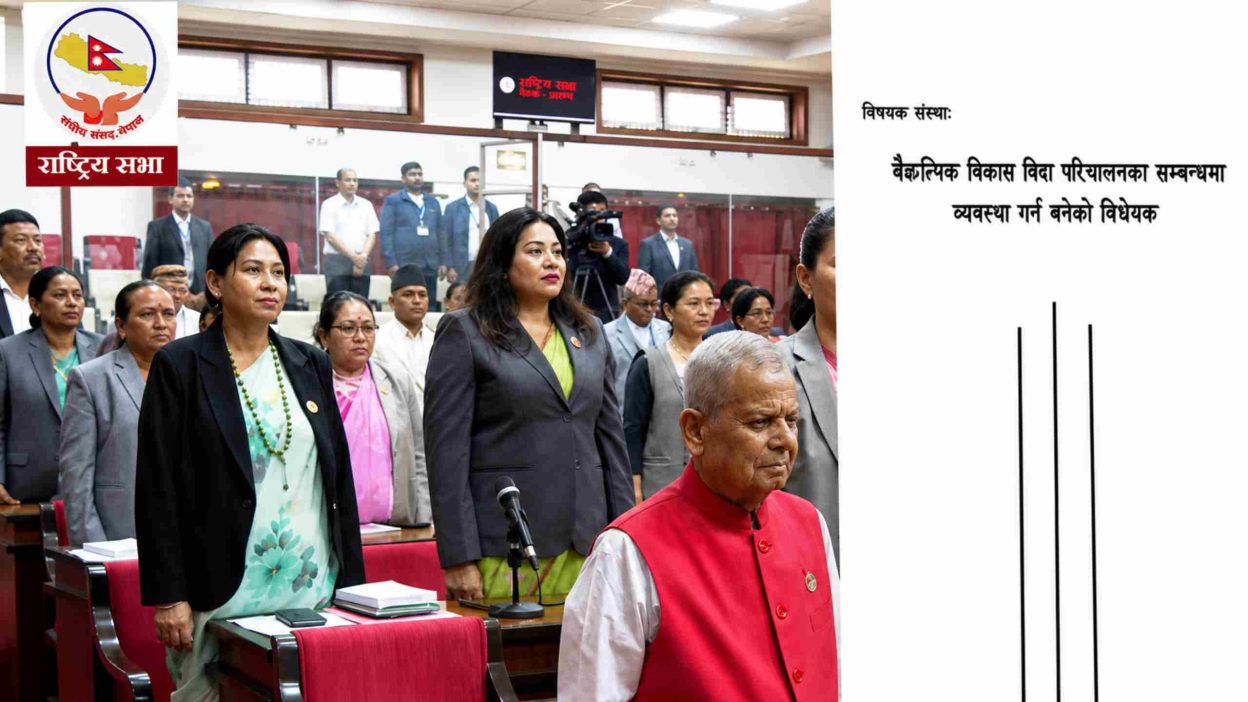
In a functioning democracy, the smooth passage of laws between the lower and upper houses of parliament is taken for granted. However, Nepal’s federal parliament has just set a frustrating new precedent.
The National Assembly (the upper house) recently set a new record for legislative stagnation after failing to pass the Alternative Development Finance Mobilization Bill (Waikalpik Bikas Bitta Parichalan Bidheyak) within its constitutionally mandated timeline.
Despite already clearing the House of Representatives (the lower house), the crucial economic bill expired in legislative limbo, highlighting growing efficiency issues within Nepal’s upper chamber.
The Deadline Dilemma: What Went Wrong?
Under the parliamentary regulations governing Nepal’s federal setup, the National Assembly is bound by a strict clock. Once a bill is passed by the House of Representatives and sent upward, the upper house has a fixed window to deliberate, amend, and vote on it.
For the Alternative Development Finance Mobilization Bill, the hard deadline was fixed for Jestha 22 (June 5).
However, instead of moving through the final stages of parliamentary voting, the bill never even made it to the floor for a decision. Rather than being rejected or heavily amended, the legislation effectively timed out because the assembly failed to move the bureaucratic gears fast enough.
Why the Alternative Development Finance Bill Matters
This isn’t just a failure of procedural paperwork; it has real economic consequences. The Alternative Development Finance Mobilization Bill was designed to reshape how Nepal funds large-scale infrastructure and provincial development projects.
Traditional foreign aid and domestic tax revenues are no longer enough to meet Nepal’s ambitious development goals. This bill aimed to regulate and mobilize alternative financial instruments, such as:
Blended Finance: Combining concessional public funds with private commercial capital.
Green Bonds: Raising climate-centric investments for clean energy and sustainable infrastructure.
Public-Private Partnerships (PPPs): Creating robust legal frameworks to attract private equity into public infrastructure.
By failing to pass the bill, the government’s plans to diversify its development funding have been dealt a significant bureaucratic blow.
Structural Bottlenecks in the National Assembly
According to parliamentary observers, this unprecedented failure points to deeper systemic issues within the National Assembly’s recent sessions.
[Lower House Passes Bill] ➔ [Sent to Upper House] ➔ [60-Day Review Window Opens] ➔ [Deadline Expires Without a Vote]
Several factors contributed to this historic delay:
Prolonged Political Disagreements: Frequent disputes and shifting alliances among the ruling and opposition coalitions have consistently derailed regular house business.
Committee-Level Delays: Crucial specialized committees tasked with vetting financial regulations spent too much time locked in debate without reaching a consensus.
Session Management Flaws: Poor scheduling of the assembly’s calendar meant that critical legislative work was pushed aside by political grandstanding and urgent financial debates over the national budget.
What Happens Next?
Because the National Assembly missed the hard statutory deadline, the bill cannot simply be picked back up where it was left off.
To revive the legislation, the executive branch will have to reintroduce the bill from scratch in the lower house, resetting a legislative process that has already taken months of parliamentary time. Alternatively, if the development funding gap becomes desperate, the government might resort to an ordinance (Adhyadesh), a temporary law passed via presidential decree while parliament is not in session. However, relying on ordinances is heavily criticized as an undemocratic shortcut.
As Nepal faces widening fiscal gaps and urgent infrastructure needs, this new record of parliamentary inaction serves as a stark reminder: when politics stalls procedure, the country’s development pays the price.