
The massive boom in Artificial Intelligence (AI) has completely rewritten the playbook for semiconductor investors. While massive graphics processing unit (GPU) designers usually steal the spotlight, the hidden backbone of the entire AI ecosystem is memory.
This brings us to Micron Technology (NASDAQ: MU), one of the world’s primary manufacturers of computer memory and data storage.
If you are considering adding Micron to your portfolio, evaluating the company requires looking past short-term buzz. The memory industry behaves very differently from traditional software or logic chip companies. Before pulling the trigger, investors need to understand two structural drivers that dictate Micron’s long-term performance: extreme cyclicality and the high-margin AI hardware transition.
Factor 1: The Double-Edged Sword of Memory Cyclicality
The single most vital concept to understand about Micron is that memory is historically treated as a commodity. Unlike custom processors, standard dynamic random-access memory (DRAM) and flash storage (NAND) chips are highly standardized.
Because of this commodity status, Micron’s revenue operates on an intense boom-and-bust cycle governed by supply and demand imbalance:
The Boom Phase: Demand outstrips supply (often driven by new smartphone cycles, PC upgrades, or data center expansion). Memory prices skyrocket, and Micron experiences explosive profit growth and margin expansion.
The Bust Phase: Seeing high prices, manufacturers increase production capacity. Eventually, supply overshoots demand. Inventory builds up, chip prices plunge, and Micron can face steep losses even while shipping high volumes of chips.
Investor Takeaway: Evaluating Micron purely on trailing price-to-earnings (P/E) ratios can be incredibly deceptive. Often, Micron looks cheapest right at the peak of the cycle (when earnings are unsustainably high) and looks most expensive or unprofitable at the cyclical bottom, which is historically the better time to buy.
Factor 2: The High-Margin AI Premium (HBM)
The current market cycle has a massive structural differentiator: High Bandwidth Memory (HBM).
Artificial intelligence models process astronomical amounts of data every second. Standard memory chips create a “bottleneck,” slowing down powerful AI processors. To solve this, memory makers stack DRAM chips vertically to create HBM, which provides the massive data pipelines that AI chips require.

This structural shift transforms Micron from a pure commodity supplier into a high-value technology partner:
Massive Premium Pricing: HBM chips command significantly higher average selling prices (ASPs) and vastly superior profit margins compared to standard PC or mobile memory.
Capacity Constraints Protect Pricing: Manufacturing HBM requires significantly more silicon wafers than standard DRAM. This structural constraint reduces the overall global supply of regular memory, helping stabilize prices across the entire industry.
Locked-In Demand: Tech giants expanding data centers are securing HBM supplies quarters in advance, offering Micron a level of revenue visibility they rarely enjoyed in previous cycles.
Modeling the Outlook: Is It Worth the Risk?
To truly appreciate how these variables affect a potential position, use the interactive model below. Adjusting the projected growth of AI data center demand versus traditional supply expansion allows you to simulate how different phases of the memory cycle impact valuation.
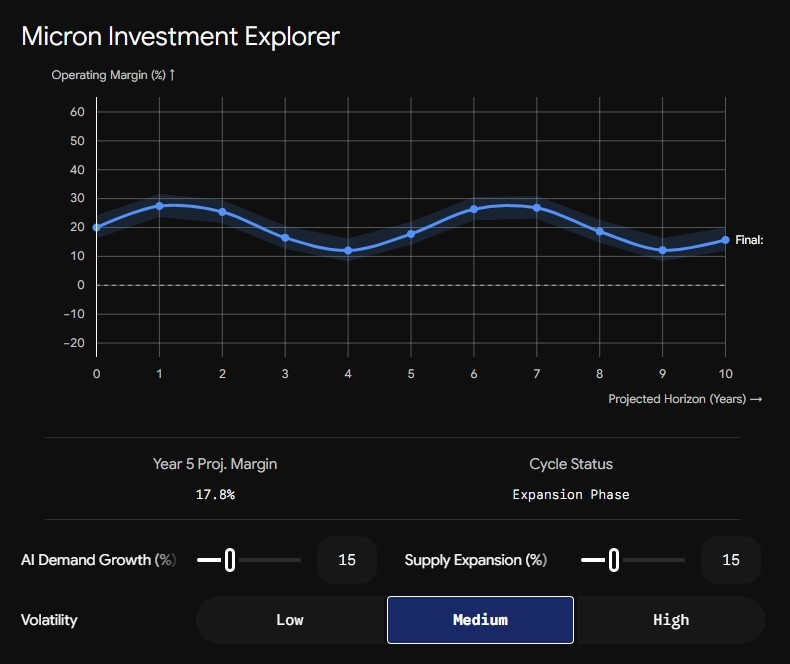
Investing in Micron means accepting a bumpier ride than traditional blue-chip technology stocks. The company’s floor is significantly safer than it was a decade ago, thanks to the indispensable nature of AI servers. However, supply gluts always remain a long-term risk in hardware manufacturing. When mapping out your thesis, monitor global data center capital expenditure alongside overall semiconductor inventory levels to gauge exactly where this volatile cycle turns next.